

Why Spot Price Doesn’t Guarantee Immediate Product Availability

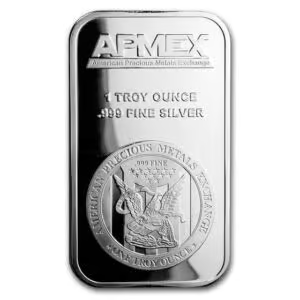
A common mistake in bullion is assuming that if the spot price is live on a screen, the product should be available to ship immediately. That is not how the physical market works. Spot price reflects a benchmark value for underlying metal exposure. It does not guarantee that a specific minted bar, silver coin or premium collectable has been refined, fabricated, struck, packaged and moved into dealer inventory. The U.S. Mint and Perth Mint production materials both make clear that there are multiple industrial steps between raw metal and finished product.1
Spot price is not the same thing as finished product supply
The bullion market operates in layers. At one level, you have underlying metal pricing. At another, you have recognised wholesale bars such as LBMA Good Delivery bars. At another, you have fabricated inputs like blanks and planchets. Only after that do you get finished retail products. LBMA says standard Good Delivery silver bars are approximately 1000oz troy ounces with minimum 999.0 fineness. Those are important wholesale units, but they are not retail coins or minted bars ready for dispatch.2
Physical product depends on fabrication, not just price discovery
A silver coin still needs refined feedstock, blank preparation, striking, inspection and packaging. The U.S. Mint says blanks for bullion coins are bought and then processed through annealing, washing and upsetting before striking. The Perth Mint says blanks, the same one’s used to make the kangaroo 1oz silver bullion coins, are burnished and may be acid-washed, ultrasonically cleaned or pickled before coining, with finished coins then inspected and packaged. So even if the metal price is available in real time, the physical product still depends on a slower manufacturing chain.
This is why “silver exists” can still mean “out of stock”
The Perth Mint’s January 2026 statement is one of the clearest examples of this distinction. It said there was no shortage of silver at the Mint, but that demand for silver in specific forms had created manufacturing pressure and significant backlog. That is the perfect explanation for why spot price visibility does not automatically translate into immediate product availability.
Tight physical markets make the disconnect worse
When the silver market is in deficit or facing logistical stress, the gap between benchmark pricing and product availability widens. The Silver Institute said in February 2026 that the silver market was expected to remain in deficit for a sixth consecutive year and continue relying on above-ground inventory releases. Reuters reported in October 2025 that silver inflows from the U.S. and China were needed to ease a London liquidity crunch, while about 83% of London vault silver was allocated. That kind of environment is exactly when buyers feel the disconnect between what the screen says and what the shelf can deliver.
Spot price does not tell you which form of silver is tight
This is a big one. “Silver” is not one monolithic product. A wholesale bar, a fabricated blank, a one-ounce bullion coin, a proof coin and a minted bar in assay all sit at different points in the production chain. A market can have enough wholesale silver to support a spot benchmark while still being short of fabricated blanks or finished premium products. That is why customers can see a live price and still face long lead times on specific items.
Why premiums and lead times are often better signals
In tight physical markets, the stress usually shows up first in premiums, dealer allocation limits, revised ETAs and uneven stock availability. Reuters’ reporting on London tightness, Silver Institute deficit forecasts and Perth Mint’s backlog comments all point in the same direction: the physical market can remain functional while becoming much harder to source from cleanly and quickly.3
Final thoughts
Spot price is useful, but it is not a promise. It tells you where benchmark metal is trading, not whether your exact silver or gold product is ready to leave a mint, clear quality control, receive packaging and reach a dealer. Once you understand the difference between benchmark pricing and physical product availability, a lot of bullion-market confusion disappears.
- https://www.usmint.gov/learn/production-process/coin-production ↩︎
- https://www.lbma.org.uk/publications/good-delivery-rules/technical-specifications ↩︎
- https://www.reuters.com/world/china/tons-silver-us-china-ease-london-spot-market-squeeze-2025-10-20/ ↩︎
Other Useful material: